This was an extremely fun birding trip. The aim was to try and see and hear as many birds as possible in the Alpine local government area for the 5 days I’d be up there, and it was a huge success.
Dad couldn’t make it, neither could any of my mates, but I enjoy solo trips just as much.
I have actually been to the Alpine region a few times now, mostly on hikes in the high altitudes of the national park. Part of the appeal of birding Alpine was that I already had a bit of a connection with the area. I already had some good birds that I wouldn’t see again on this trip, like White-browed Woodswallow and Eurasian Skylark, which is still the only record in the region. It seems to be a very underrated area, with few birders visiting and no main bird-related attractions that are hard to find elsewhere. Because of this, securing a leaderboard position is fairly simple- even becoming the mayor eventually (all-time most bird species seen and heard) is not an unreasonable goal.
These kind of trips take a lot of planning, looking at naturekit habitat maps, old ebird and ala records, and finding the optimal path between locations, birding the forests and woodlands in the mornings and evenings and the wetlands/treatment plants/dams in the heat of the day, as well as being able to adapt quickly to dips and successes to cut out or add locations to the itinerary as I went as necessary. I had been looking forward to this trip for a fair few months!
There were 5 main sorts of areas that provided the most diverse ticks from each other:
Dry, open grassy woodlands
Wet Forests
Grasslands/paddocks in the valleys
Wetlands
Sewage Treatment Ponds
Overall, I had a very good hit rate, had an amazing time, and tried for pretty much every feasible bird.
21/1 After dinner at home in Mount Evelyn, I sent it straight up to Gapsted, the Northwest corner of the shire, where a lot of the box-ironbark type birds for the trip would be. The first bird of the trip was a Tawny Frogmouth on Stoney Creek Road, which runs along a gully parallel to a (currently dry) creek, with a mix of denser and open areas and forest edge, plus lots of small dams on private property, increasing the threshold for how many birds can occupy the area. The second bird was a calling Australian Owlet-Nightjar, which I did not get views of as I set up my tent. #3 was a wood duck calling as it flew through before I went to sleep.
22/1 DAY #1
I woke up to a really good dawn chorus, but my half-asleep brain wasn’t interpreting the calls until I packed up the tent, apart from the owlet-nightjar who was day calling, and some brown treecreepers pipping away- a good one to cross off early. The habitat here is listed as Valley Grassy Forest, and a walk down the road provided a very diverse array of birds, including a handful of the beautiful and delicate Turquoise parrots, with one very placid male feeding on the road just a few meters in front of me. I met a local and his dog going on his morning walk, and he had no idea he had such a special bird just right at his doorstep, so I told him about them and showed him the one on the road. It didn’t even care about his dog that much, and when it took off, it only flew a couple of meters away to a nearby branch over the road. Back at the car, some Shriketits were chewing the bark off a box tree looking for a snack, and a Cicadabird was calling to the north. 48 species total from that walk, including a rufous songlark that I only heard. https://ebird.org/checklist/S295581867
Definitely a beautiful location and would definitely be one of my favourite spots, if not my favourite spot from the trip.
Next, I headed east of the car into Stanley State Forest and did a loop through the thicker and drier forest, picking up a white-bellied cuckooshrike early on. Because there wasn’t a whole lot going on at the higher points, I walked down and found a skinny track winding through the valley, but there was really only a lot of blackberry (which I foraged a fair bit) and not many birds of note. I climbed back up the hill, feeling like I had made a mistake trying for the harder birds of the trip, like painted buttonquail and spotted quail-thrush, as I had been walking for around 3 hours by this point on this section, with not a whole lot going on. Don’t get me wrong, it was still a very pleasant walk, but I was wondering if I was pushing my luck too much. I was now on Flagstaff Road, then turning south onto Gapsted track, my ears pricked up to the high-pitched seep contact call of a Spotted Quail-Thrush! I was very excited, I hadn’t seen any before, but had spent many hours searching for them further southwest in the Yarra Ranges. Patience provided some great views of both a male and a female crossing the road and moving around stealthily, my one lifer for the trip. https://ebird.org/checklist/S295581905
The Cicadas had started up, meaning it was now too hot for bush birding to be worthwhile, as a lot of activity dies down as birds seek shelter from the heat or continue to forage quietly. So I headed off to the Myrtleford Sewage ponds, aircon blasting, and scoped out the ponds and all the waterbirds from my window with my new 16-32x stabilised spotter, which I had been saving up for for a long time. Over the course of this trip, it was definitely my best friend and an invaluable companion to my 8×42 Vortex binoculars. https://ebird.org/checklist/S295581711
I was meaning to check out the Myrtleford Golf Club for birding purposes. On the way I stopped the car a couple of times and was able to get the two thornbills with yellow in their name, yellow thornbill on some random roadside and yellow-rumped thornbill on a second stop at a creek. At the golf club itself, I was able to secure the first plastic tick for the trip- the Common Myna, an invasive species that has been expanding its range slowly every year, and they were much easier to get now than I thought they would have been by looking at the records. I made sure to record every sighting I had over the course of the trip, and found a depressing 23 birds over the 5 days in the valleys, farmland and towns. As of yet, Mount Beauty has no records, but it’s only a matter of time. I found one at both Mongans Bridge and Coral Bank on the 23rd. The golf club itself was ok birding, a crested pigeon, goldfinches, and a few other nice birds. The people there playing golf were quite friendly, though you always have to be very careful not to get in their way, unless you want your brains, teeth, or eyeball replaced with a golf ball. https://ebird.org/checklist/S295587864
The Ovens River is a key landmark in the region, and the Ovens River walk looked like a very pleasant place to check out, and if I was lucky, I might be able to spot an azure kingfisher or platypus- I have yet to see a wild platypus surprisingly. There were plenty of Noisy Friarbirds and the sweet-sounding White-throated Gerygones, but no Little Friarbirds, despite my careful scanning. On the way, there was a very chill Tiger Snake sunning itself on the path. The girl in front of me who was going on her afternoon run was not keen to go past it. A bit of an unintentional “you shall not pass” moment by the snake, despite his peaceful, non-aggressive, and happy-to-be-alive nature. Another family came by on their bikes, also unwilling to pass. I walked past the snake to show them it was ok and not to agitate it, but the Dad insisted on flicking it off the path using a long stick, which he did, despite the strong discouragement from the rest of his family. It didn’t appreciate it, but was too lazy to do much about it.
A pair of Blue-faced Honeyeaters were at the other end, before I turned back. Another nice spot! https://ebird.org/checklist/S295593365
With a few dry forest birds to tick off still, I headed back to Gapsted, exploring a different section of the trail, with a tiny chance of white-throated nightjar on sunset, which would be an eBird first for Alpine. There’s one record on ALA for them near the spot I went, the “Gapsted track at Bluebell crossing” Hotspot on eBird. I love swifts, and any day I get to see Needletails soaring over is a good day, and today was already a good day- the addition of the needletails above that I was even able to get my IS scope on them in 32x was truly awesome. The evening walk also provided a couple more Gang-gangs, male and female Leaden flycatchers, as well as more buff-rumped thornbills and fuscous honeyeaters.
Afterwards, I headed back to Myrtleford again to try and hear a Pacific Koel, a noisy Cuckoo that calls most consistently at sunrise and sunset. 20 years ago, any sighting in the state was significant. But their range has been expanding south since then, becoming more regular in towns across more and more of Victoria every summer, and in Mount Evelyn we’ve had one or two that are now regular summer visitors every year. Back near the golf club, just next to it, I spent the last light listening out for the distinctive call and dipped.
I then went back down to the Myrtleford sewage ponds to see if I could find any nocturnal stuff, which I did- 2 more tawny frogmouths, in just 15 minutes. There are a TON of bugs around there to eat, thanks to the nearby ponds, so it makes sense.
I went and set up my tent near Taylor’s Gap- thinking I would try the next morning for what would be a possible very endangered local population of speckled warblers, and maybe even the Alpine mega noisy miner. (This was after trying to head up the other side of Flagstaff Road to camp there so I could have another crack at painted buttonquail first thing in the morning- unfortunately, there was a huge tree over the road. I had to do a 7-point turn to escape.
23/1/26 DAY #2
The spot I camped (which was right next to the road) didn’t have nearly as good a dawn chorus as the first morning, but I was still able to see some nice birds walking around Taylors Gap. A pair of wedge-tailed eagles perched on a dead tree overlooking an incredible view, 4 leaden flycatchers, some choughs, sittellas, a bronzewing, and the #1 highlight and the first surprising record and rarity for the trip- the beautiful song of the Pied Butcherbird singing its heart out on the alpine side of the bike track that goes through Taylors Gap. I was unable to get eyes on it, but the call is very distinct, and I was very happy to hear it! Definitely on the southern end of its range there. https://ebird.org/checklist/S295702519
On the way back, I had a nice encounter with some Varied Sittellas too.
Next stop: back to Stoney Creek Road. I wanted to confirm it was in fact a Rufous Songlark that I heard yesterday, and this spot still had the best chances at giving me a few more of the box-ironbark and dry forest type birds that I would otherwise likely miss. In fact, just as I was hoping, just walking around the open areas on the edge of the forest did exactly what I hoped it would. I was able to snag some more really great birds! On the south side of the road, not only did I get to see the rufous songlark up close but also a locally uncommon Peaceful Dove, Collared Sparrowhawk, White-throated Needletails flying high above, more Turquoise Parrots, Tree Martins, and one of the highlights of the trip: two Diamond Firetails!! Beautifully coloured little finches with a bright red tail and beak, with little white spots along their black flanks, giving them their name. On the north side, a male Cicadabird, Jacky-Winter and a male Restless Flycatcher (who responded very curiously to my pishing) all came to say hello. As I was leaving, I also picked up the distant calls of two Red-rumped Parrots. What a great spot, definitely one of the essential locations for alpine listing. https://ebird.org/checklist/S295722090
Happy with my successes in the northwest of the shire, I decided it was time to move on to the rest of the itinerary. First stop- Apex Park, Myrtleford, for a quick brunch break. The temperature was quickly rising, a feature of this trip was definitely the timing of bush birding as the days regularly climbed to the low to mid 30s. My next target ecosystem was the open grasslands/farmlands of the Happy Valley and Kiewa Valley, including trying to snag some good wetland birds, mostly scoping dams/wetlands on private property from the road. I’d stop the car regularly, checking and listening. Managed to snag 5 pelicans flying over the valley distantly this way, as well as various ducks, fairy martins, white-plumed honeyeaters, and after some great views over the mountains cresting a tall forested hill, Kiewa valley provided more red-rumped parrots at the junction of Kiewa valley highway and running creek road. The common mynas were also a feature of the paddocks, unfortunately, much more common than I expected while planning this trip. The end of the valley led me to the ever-popular Mount Beauty, famous for its proximity to skiing resorts, beautiful landscapes and of course, the town itself is really cozy, though Bright probably takes the cake for cozy towns in Alpine. Less famous for its birdlife, the Alpine region is already a fairly neglected area by birdwatchers, despite its stunning natural beauty, as diversity is generally lower in the high country, and the birds you can find here you can usually find elsewhere. Good thing LGA listers exist! The Mount Beauty pondage is an important site locally for crakes and rails in summer, as well as Latham’s Snipe and various waterbirds. I was fortunate to see a single male Chestnut Teal, many Latham’s Snipes, ducks, cormorants and swans, and some very overdue Yellow-tailed Black Cockatoos, but no crakes or rails. The water levels were surprisingly high despite the lack of rain in the region recently, though I think the water levels are controlled. https://ebird.org/checklist/S295743773
The nearby Mermaid Beach and Rock Pool site is a really gorgeous little swimming spot, where the east branch of the Kiewa River created a really good spot for diving in the 1900s, where there was a deep spot. Here is also a well-known spring/summer site for the extraordinarily colourful rainbow bee-eater, where a sighting is basically guaranteed. I counted about 6 individuals while I was there, but I did also visit the actual swimming holes and had a chat with some holidaymakers about the gorgeous bee-eaters that were right under their noses!
https://ebird.org/checklist/S295746496
The valleys still had many more grassland birds to show, so just like the double visit to Stony Creek Road, I decided it was a strategically big brain move to give it a second crack, this time with a bit of the evening vocal activity. Driving slowly, scanning fences and wires with the windows down, it quickly became apparent that this was definitely a good move. I wasn’t even that far out of Mount Beauty when I got the locally rare (at least considered to be) golden-headed cisticola, belting out its buzzes and chips from a fence post, with a second bird not far behind doing the same thing. https://ebird.org/checklist/S295748159
I noticed more raptors than last time, too, another Nankeen Kestrel, and a Black-shouldered Kite on a power line. 3 more Rufous Songlarks near a rest stop, then in the happy valley, ANOTHER cisticola, and possibly the best bird of the trip- a male BROWN SONGLARK perched atop a fence post. I was so excited. With only one other record in the shire, even if I hadn’t found anything else, this was well worth backtracking for. Oh, then another cisticola.
https://ebird.org/checklist/S295752816
I wanted to check one more wetland before it got dark, near the spot where I was hoping to land some Shelducks. No shelducks, but a brown falcon having a skirmish with a nankeen kestrel made a nice addition to the day’s list of ticks. Though my luck wasn’t over yet, even though I couldn’t hear a single stubble quail, a great egret flew over on my way back- the sun was now set, and I started losing hope that I’d get onto a stubble quail. I was very close to getting booked for a speeding ticket on the way back to Mount Beauty, probably just another 1kmph faster, and I would have gotten a fine, but luckily for me, I was still in luck- and I didn’t even have to trade it for a stubble quail dip. I just rocked up to a pin from two years ago outside mount beauty where zebedee muller had a handful of stubble quail, and waited, waited, for 15 minutes, in the dark, and somehow- there was a stubble quail and even though it should have been asleep by then, it made a loud “pippy whit!” call- silent victory dance and fist pump! It did that 3 more times, and then went silent. Tick! https://ebird.org/checklist/S295759901
24/1/26- DAY #3
I tried the Mount Beauty pondage this morning for crakes/rails, dipped again, same birds as yesterday, and no Pacific Koel, which I should have heard given prior records earlier this summer. It’s fine, I thought, I’ve got plenty of other opportunities to hear one in a bunch of other spots. I did talk to a local who I showed the call to (a very distinct noise, even for non-birders!), she said she had heard it a bit back, not too long ago, coming from the north of the pondage.
Next target ecosystem: Wet forest! I was looking forward to this part of the trip, so many cool spots to explore, and the Great Dividing Range is very mysterious in a lot of ways, and so huge. Driving down the road down from mount beauty to bogong I heard an eastern whipbird before stopping at a track (Roper track) that goes town to the same river as mermaid beach (Kiewa River east branch) super beautiful spot, the river was pretty enchanting when I got down to it, a few nice birds too- the most cicadabirds of any spot on the trip (3), a few lyrebirds and hyacinth orchids. https://ebird.org/checklist/S295853875
I had a stop and listen near Clover Dam, another place where the scale of the landscape somehow makes you feel like you’re endlessly curious about what’s hiding around each corner, even though the birds I did get there were fairly underwhelming. The Clover Dam is one of a few manmade dams in the Kiewa River to generate hydro power under the Kiewa Hydro-Electric Scheme, which is the largest hydro system in Victoria and the second biggest in Australia. The Mount Beauty pondage, pretty valley pondage, Lake Guy and Rocky Valley storage are all part of this hydro system too. Another couple of stops at random points on the road where a creek runs through had a rose robin, rufous fantail, crescent honeyeater, satin flycatcher (with good views of males to confirm) and a brown goshawk/collared sparrowhawk- which I only heard. I’m not super great at splitting them on calls yet, but I did record the call in case someone else could- because if it was brown goshawk it’d be another tick. Very strange habitat for a grey butcherbird, but I definitely heard one, without a doubt. Next stop along the river is Lake Guy, in Bogong. The walk around that lake was very productive, even though the weather was quickly warming up again. A really scenic spot, it used to be a very popular holiday destination/ town where hydro workers lived in the Bogong Village. Though it saw a decline in popularity as a general tourist destination due to a shift away from its original purpose as a 1940s Kiewa Hydro-Electric Scheme worker township, compounded by a lack of maintenance on properties for several years. I did wonder why everything looked closed and a bit run-down. I did meet a lovely couple who are friends with the owners of the village or something, and told me a big company was going to buy it or had bought it to fancy it up and make it popular again, and to enjoy the lake while it was a quiet location. That company obviously sees potential here. Walking around the (very beautiful) lake, and ticking heard only red-browed treecreeper, wonga pigeon and brush cuckoo, I met an elderly american couple wielding well known binocular models (in fact the guy had the exact same as me) who were very interested in all the bird knowledge I had to share with them, and were kicking themselves that they didn’t know about the rainbow bee-eaters at mermaid beach because they were just there earlier! I had lunch at the Rocky Valley Gorge. It was now well and truly hot!
https://ebird.org/checklist/S295881201
A trip down to Bogong would be incomplete without a visit to Fainters Falls, and a Lewin’s honeyeater has been seen here before. I doubted I would find one; I barely found any birds at all. I did find a yellow-bellied water skink, and of course the waterfall itself is an impressive sight to behold. https://ebird.org/checklist/S295891018. A lot of tourists at this spot as well.
I was keen on seeing some of the other wildlife unique to the alpine region- even though there’s nothing even close to any kind of endemic birdlife here (though there are a LOT of flame robins and pipits) it’s a whole other story for frogs, reptiles, mammals, and ESPECIALLY invertebrates and plants. My friend on a bugging trip up to the high plains actually discovered a new species of peacock spider that is still yet to be described. I wanted to try and see if I could find some of the special terrestrial orchid gems that grow unpredictably in the area, especially around Mt Hotham and Falls Creek. So I rocked up to Falls Creek, which is an LGA (actually an UIA, unincorporated area) in its own right. I drove around and walked to some different spots where there were iNaturalist and ALA pins on certain rare orchid communities. Looking for orchids is not something I spend a lot of time doing, (though it’s something I definitely would love to do more) so my eyes aren’t super trained for it, though I like to think that my job (looking in the ground for weeds and good plants and then removing those weeds/protecting the good plants) would help somewhat. I was able to find the delicate Small Alpine Leek Orchid, and the Mauve Leek Orchids, though the latter weren’t flowering.
There are some unspecific location records of the microendemic Don’s spider orchid coming up into Alpine, but finding those would be a matter of knowing the right people, plus likely restricted/secretive/private property/highly endangered and all the usual sensitivities around rare plants. I also couldn’t find the Large Mountain Greenhood in Falls Creek, though I was thrilled further down the road to find a large colony of Swamp Sun Orchids, also known as Cyan Sun Orchid/Veined Sun Orchid (Thelymitra cyanea).
After that, I left the shire briefly, going around through Omeo (the road through which had only recently opened a day or so before I went on it!) and some of the most under-explored places in Victoria along the Great Dividing Range, likely harbouring secrets that no naturalist has ever laid eyes on. The road had only just opened the day before- because of the bushfire risks- so it was timed perfectly, so proud of how well I planned that. I stopped at a pin in some dry forest, near a river where platypus are known to occur, to look for a report of Highland Sun-Orchid, though I was unable to find it. It’s possible that it had concluded flowering already. https://ebird.org/checklist/S295906817
The vegetation and scenery changed pretty rapidly coming down the divide into the Omeo Valley area into open fields. There was this electric green grasshopper that somehow ended up in my car and wasn’t smart enough to find out how to get out. I had seen a bunch around but was never able to capture one for an iNaturalist photo, so I kind of just left it there for later, but kept forgetting about it every time I got out of the car. It had successfully hitched a ride to the other side of the great dividing range. I filled up petrol (very expensive for a self-serve) and continued on to Dinner Plain. Driving up there, I was filled with pleasant memories of hiking around here with mates. I was keeping an eye out for emus- my main reason for making the trek up here, as well as for the orchids. I drove up and down the plain, visited the airport, flour bag plain, tried JB plain, all the plains- nothing. I spent the entire rest of the day until sundown- around an hour and a half of vigorous scanning. I did find a deer this way near the airport, and got a couple other nice birds for the list, like scarlet robin, but tragically no emus. I did also have a scan of the beautiful wildflower patch near the accommodation/town area where flowering Magenta Bunny Orchids had been seen- didn’t find any though- it would have been an enormous highlight if I did. I set up my tent that night near the JB hut so I could give the emus one last crack the next day.
25/1/26- DAY #4
The next morning, I woke up to the peaceful noises of JB plain. I got up very early and scanned the plain with my scope, waiting for an emu to maybe run across. None did, but an olive whistler whistled nearby. So I got in the car for one final desperate attempt, driving up and down the dinner plains scanning every open area. No luck.
https://ebird.org/checklist/S296050068
It was time to move on to Mt Hotham- another UIA – an LGA list to be filled in in its own right. I stopped to eBird nearly every bird I saw and heard, a total of 19, including a very confiding pair of Gang-gang Cockatoos I got some great digiscope footage of through the car window mount and scope, and an eastern spinebill and pilotbird near the lower elevation border back with Alpine Shire. Definitely a very beautiful place, and I’ll definitely have to come back and do more hikes around there. There’s more cool orchids to be found here, too. If I had time, I would have chased up a Graceful (Collared) Sun-Orchid that was reported on inat, but it would be quite a hike to the spot in itself.
https://ebird.org/checklist/S296074074
The Alpine side nearby had a pilotbird of its own for the trip report list, too.
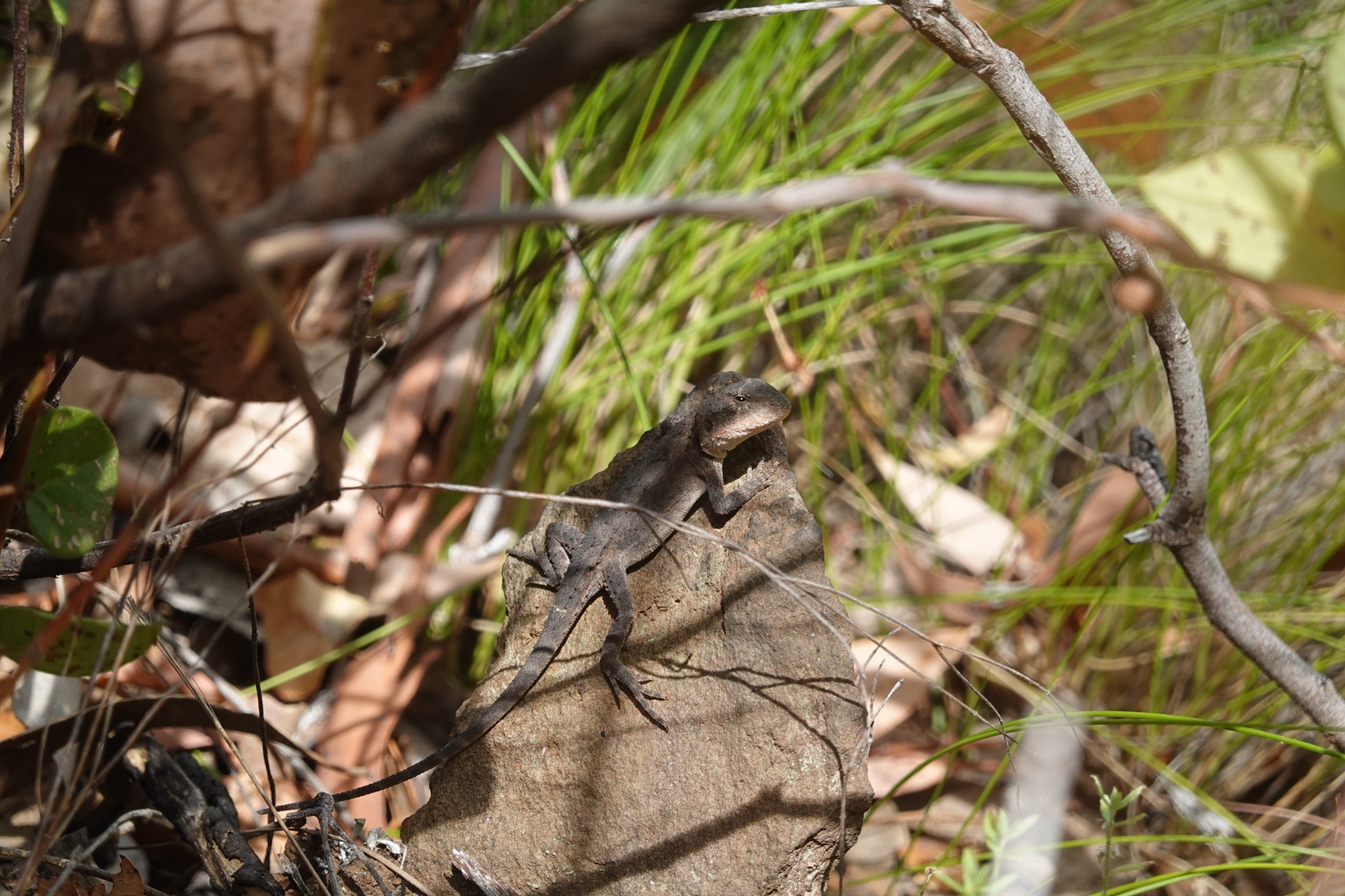
The next destination I decided would be the Bungalow spur track, where I was hoping for a single reptile target- the Mountain Dragon. Initially, this idea itself was formulated much earlier, back at home when the itinerary of this trip was still in the baby stages. I was actually going to go to Selwyn to go spotlighting for Masked and Sooty owl, and maybe even make it to a spot for Pale Goat-Orchids if it was in season for them (which it wasn’t). However, the big bushfires around Dargo placed that destination dangerously close to the fire, right next to it in fact, and I was completely not allowed to go there, so I made a change of plans. The Dragon Itself, it isn’t insanely rare or anything, though not common either- but herping is something I want to get more into, and setting myself on a mission to find this awesome-looking lizard with an equally awesome name actually turned out to be very fun and rewarding. The hike itself, which starts near Harrietville, started in a wet forest gully which had a couple of Red-browed Treecreepers to complement the one I heard the day before in Bogong- this time I got to see one too. 2 Rufous Fantails, and another strange Grey Butcherbird calling. As the climb elevated above the wet forest, the vegetation changed, and because of the time of day, as the temperature was still mild but rising, all the skinks and reptiles were out sunning themselves on the rocks next to the path and on the path itself. I don’t think I have ever seen so many skinks in my life, but then again, I haven’t explicitly been looking for lizards much in my time as of yet. It took almost a couple of hours, but I finally stumbled across the mountain dragon, and I was so excited. All of a sudden, I was just looking at one. I was able to get some great photos using the family RX100 VII, which I have basically used into the ground- the lens barely comes out of the body anymore because of sand in the mechanism… But the mountain dragon was so much more chill than the other skinks and I was able to sort out the camera fast enough to get some great shots of him sunning himself and looking real content with life, probably projecting it on the little guy based on my own personal state of being in that moment, but how could he not be? It was such a beautiful day, and he had such a great view to admire! On the way down, I also inatted a skink that was climbing on a tree trunk, and it turned out to be called the “trunk-climbing skink”, another reptile lifer. I laughed when I saw the name, what a creative name I thought in irony.
https://ebird.org/checklist/S296099045
I stopped at the Wandiligong Camping Ground for lunch, to try and twitch a Lewin’s honeyeater that had been seen there just over a week prior. I didn’t get anything, though I was mainly just listening out for it while I ate, and given the time of day, I wasn’t expecting it to be particularly vocal, so I planned to come back that evening.
The bright sewage ponds had much less to offer than the Myrtleford ones. It was getting really hot, and I was barely able to pick up 12 species during the 30 minutes I was there. The surrounding pine plantation definitely affected the bush bird diversity; the enormous thistle and blackberry infestations also added to the dead vibes of the place. Only 3 species of ducks, the moorhens and coots, both grebes, and a pair of masked lapwings. Most of the ducks were grey teals with a few black ducks and hardheads. Depressing. I triple checked every pond, too. Time to move on, I decided.
https://ebird.org/checklist/S296107518
Now in Telford Lane, Porepunkah, Linda Hayes’ stomping ground (the “mayor” of Alpine, a term of respect to recognise the person who has recorded the most species of birds in a certain LGA), who has submitted more lists here than pretty much anywhere else. And no, I did not find any on-the-run murderers… I wish I did, there was a A$1 million reward for information leading to his arrest, which is the largest reward ever offered in Victorian history! This of course is in reference to the very recent, horrifically tragic and heartbreaking shooting of 2 police officers, Vadim De Waart-Hottart and Neal Thompsonin, in Porepunkah on 80 Raynar track [an aside, some actual decent looking bushland I might bird at some point] on the 26th of August 2025 at 10:37am- while trying to execute a warrant. By a matter of national interest (maybe even international interest- gun deaths, especially police gun deaths, are extremely rare in Australia) and important Alpine lore, Dezi Freeman is currently on the run and barely still a Free Man, and at the time of me being in porepunkah, there were still around 500 officials looking for the guy. [as of writing this up, Freeman had been found after a 7 month manhunt and “shot dead by Victoria Police on March 30, 2026, during a [3 hour long] standoff at an isolated property in Thologolong, Victoria, near the New South Wales border. He was killed around 8:30 am after a three-hour standoff with the Specialist Operations Group, where he was found living in a shipping container on a remote property near the Murray River” Investigation over his death shows he was shot over 20 times- my good mate Ethan’s Mum wonders if the Police there had a sense of vengeance for their fallen brothers… Not trying to be insensitive, it is a very tragic story, I just find the whole situation very fascinating. And it’s important info to add, I feel. None of this I actually knew at the time.
The temperature was at this point very high, at 2:44pm when I got out of the car and started birding the place. At first, I heard a strange call- was that a dollarbird? I played calls. Nothing. I dismissed it. Spotted dove, Little Eagle, and maybe even Dollarbird if I was lucky were my targets. I almost got none of them, but just so happened to look up at the far end from where I parked my car and see a pair of light morph Little eagles riding the thermals! Huge win! And another Alpine tick. I then headed back to the car. A few other more common birds padded out the experience, and some exploring to the end of the road revealed a caravan park, and the river, which runs parallel to the end of the road also had attracted a few people trying to cool off from the harsh summer heat. Just as I was about to get in the car, I heard the mystery call again, and realised there was a PAIR OF DOLLARBIRDS DIRECTLY ABOVE MY CAR! I laugh, my luck just keeps getting better, this whole trip just can’t get any better I thought. I even got a digiscope of one, panting at the top of a dead tree, trying to catch some breeze under its wings to cool off. What a quality spot!
https://ebird.org/checklist/S296112834
LAKE BUFFALO
Lake Buffalo was one of the main highlights of the trip. The drive in was pretty scenic, of course. When I arrived, I quickly realised just how busy a popular tourist destination could become on Australia Day- with jet skis and boats all over the lake. Near the dam wall, as I drove past, I stopped to look through my scope and made out a male Musk Duck and a handful of Great Crested Grebes, more great ticks to have. I would stop the car every time there was a clear spot to see through to the lake. I stopped at Neil’s rest area, where I saw another Musk Duck, all expected cormorants, Darter, Pelicans, both Herons, 2 Latham’s Snipe on the far side, a Whistling Kite on a dead branch, and some of the best birds: a single Eastern Cattle Egret hanging out with a cow on the far side, a single male Chestnut Teal and SWAMP HARRIER (locally rare) took off from right nearby me, and the #1 highlight, a very confiding Spotted Crake right at the waters edge foraging in the mud- right in front of me, with me not aware of it’s presence until I looked down! The moment we both registered each other’s presence, we both got a bit of a fright, but then after hopping onto a log and looking me over, it decided I was no threat and continued foraging within a couple of meters from where I was standing! I was able to look through my scope at it, and at that close range, the close focus really shone and I was able to get some INCREDIBLE detail, filling up my entire view while I was gawking at this thing, the best views I’ve ever had of a crake. It’s like I was holding it in my hands. Driving all around the whole lake also produced a lot of bush birds as well, giving a really nice total tally for the list at the end of 64, plus a leaden/satin flycatcher I heard. At one point, when I stopped the car and the grasshopper that was STILL in my car this whole time was trying to escape once again and I went oh yeah, you’re still here! And tried to get a photo of it. It nearly escaped, but I got a photo that I quickly got to genus level before releasing it. I can’t even remember when it flew into the car. My gut says sometime around the Happy Valley, but I’m not really sure. It got quite the ride in the end. I continued looking for Caspian Tern and White-bellied Sea-Eagle around the lake, didn’t find either. No black-fronted dotterels either. But a really nice spot, I’d definitely come back, a key spot for Alpine listing for sure, up there with the Gapsted Woodlands in terms of general enjoyment and vibes I personally reckon.
At this point I was still keeping a careful eye on the bushfires both up in Towong and down in Dargo that I was sandwiched between, though they hadn’t made any ground towards me, or spotfires near that I could see- no warnings or anything, so it was all good.
The Alpine Sun Orchid did cross my mind, but the name is somewhat misleading- there aren’t actually any Alpine Sun Orchids in Alpine. They’re in the northwest East Gippsland/Towong area (some of which may have actually been on fire at the time). So I’ll have to do a trek up there another spring.
Time to race to a spot where I can finally hear a koel. I’ll get it this time, for sure, I thought. I Incidentalled all the nankeen kestrels and wedgies along the way, until I got back to the Lewin’s honeyeater spot, which is actually also a koel spot. Except now, the caravan park was way busier than before. Caravans everywhere, kids playing with their families, people walking around. I went to the Lewins Honeyeater spot and had no luck. I desperately wanted to get a Koel on the list as well, so I asked a random dude who was in the middle of a game of frisbee if he could keep an ear out for this bird- I told him it was a Lewin’s honeyeater, showed him the call and told him what I was doing. I had set up a sentinel of sorts, giving him my number- an LGA grind tactic that I am coining right now because I just made it up. I did the same thing to an old couple on the other side of the park, this time with Koel, and set them up to text/call me too. I wish I had more time to talk to both of them, but alas, I had a Koel to get.
https://ebird.org/checklist/S296135873
I drove all around Bright trying to find one, all the way until it was well and truly dark. I dipped. It was really nice though exploring and walking around the super fancy parklands near the Ovens River- a lot of young couples seemed to be about, enjoying the long weekend here.
Pivoting, I headed down to Baker’s gully to see what it was like for owls. I was unpleasantly surprised by the horrific state it’s in- the amount of weeds taking over that area is pretty depressing. Pine trees, Maple Trees, blackberry, and all kinds of grossness growing everywhere. The only wildlife was a few deer (🤢). There was an evil feeling in that place I reckon, like it could be a haunted forest in a movie or something. I left and moved way off to a more pristine forest to look for owls- even a single boobook I’d be satisfied with. I walked for ~1h 45 minutes with my spotlight around Eurobin Creek Track, starting near the south end, and heading north. I found quite a few sleeping birds, making it look quite promising for birding during the daytime- a Sacred Kingfisher, Satin Bowerbird, a few Fairywrens cheeping, and I think I could hear a Rufous Fantail sleep-talking as well. The mammal life was good- Wallabies, Brushtails, Ringtails, a few Sambar deer (freaky when you know the males could instantly kill you if they wanted to), but the highlights were the wombats and a single Greater Glider. Such goofy animals. The other thing that could have killed me was Dezi Freeman. I had no idea at the time, but the shooting 5 months ago was literally 2km away from where I was spotlighting!! Spotlighting the guy who had 3 guns on him would have been a permanently crippling encounter. I forgot to mention he stole the 2 handguns off the police he killed, and local legend had it he was still wandering the bush, living off the land, maybe eating the wallabies and deer or whichever 19 year old birder that happens to cross paths with him at midnight.
Just as I was leaving after giving up on the Boobook, I heard one calling from all the way back at the south end! Woohoo! Good thing I had my windows down again while I was driving, just like the cisticolas, just in case!!
I drove back to Bright and slept in the forest near Leader Reef Drive/Ballroom Court, hoping to finally snag the Koel; at 5am the next morning or something. That was the plan, anyway…
26/1/26- DAY #5
My hopes for the Koel, despite all the attempts, both comically and tragically did not eventuate, and that was my last shot. I might’ve heard a diamond firetail or two as I was getting up, but ultimately I’m unsure.
After packing up, I drove down to Baker’s Gully, the native forest adjacent to the pine plantation- the same place I went and was grossed out by the other night. In the day, during the first part, where native vegetation is mostly dominant, I had a great run with the birds. 40 species, including calling Wonga Pigeons, Red-browed Treecreepers, Flycatchers, Whipbirds, and Rufous Fantails. Dusky Woodswallows were around, as well as the standard array of forest birds. The real reason I was here, though, was to try for Brown Goshawk, Shining-bronze Cuckoo, and the main one- Bassian Thrush. I had heard that Bassian Thrushes are known to sometimes use the edge of more mature sections of pine plantations next to wet forests in gullies, because the dense pine needles and canopy will trap moisture and can create ideal foraging conditions, so long as there is other sufficient cover to use. In my case, it was as I was walking through a horrifically weedy section full of maple trees when I heard the noise of something hopping along the leaf litter. I turned my head, and my eyes widened- I was looking at a Bassian Thrush! Similar to the well-known suburb-loving European Blackbird, but very cryptically patterned and endemic to Australia. They rely on their camouflage and rapid run-and-freeze technique to avoid detection, which sometimes allows for close observation. This was one of those times! I was very excited, and was starting to really become shocked about how good my hit rate for my targets has been this whole trip. The leaf litter from the invasive maples had made an excellent foraging layer, and because of how densely they were growing together, this adaptable bird had made use of it. It’s nice to see one of the uncommon cases where our native wildlife is able to adapt to the rapid changes in the environment around them for its benefit. The bird gave one high-pitched seep call and flew off, deeper into the maples. As expected, on the way back to the car, the bronze Cuckoo and Goshawk didn’t appear, but connecting with the Bassian Thrush was an easy tradeoff.
https://ebird.org/checklist/S296328424
I spent the next hour and a bit committing some LGA listing degeneracy, which in this case was driving all around suburban Porepunkah looking for Dezi Freeman. Just kidding. I was actually indulging in some mind-boggling plastic ticking- or at least attempting to… I was looking for Spotted Doves, the ubiquitous invasive suburban dove common in Melbourne, but only starting to colonise this part of the world around about now. A tick is a tick. I gave up after a while and only had a Blue-faced Honeyeater and a flock of 19 Crested Pigeons to compensate.
Next, I drove to Ovens. There were some records of significant numbers of resident Yellow-tufted Honeyeaters on private property, and it was a bird I needed, so I rocked up at said property to the owners painting the outside of their house. I said hi and we exchanged pleasantries and I explained what I was doing, and asked if I could come on to look for the honeyeaters. Joe and Jo were their names. They were fascinated, and more than happy to let me in to look around. It didn’t take long to find out they took great pride in the wildlife on their property, and had decent knowledge of the local birdlife, but Yellow-tufted Honeyeaters was news to them. They have a Cottage that holidaymakers or family come to stay in, it’s called “the farmer’s sharecottage” on Airbnb. I suspect it was one of those people staying there who reported the birds here a while back. Maybe string, maybe not. It was a hot day, and their sprinklers were going, being enjoyed by honeyeaters and welcome swallows. No Yellow-tufted. I walked around to the small drinking hole up the top of the property, where the forest becomes more wet and dense. There were Sacred Kingfishers, Gang-gang cockatoos, Blue-faced Honeyeaters, White-throated Gerygones, Mistletoebirds, and a Red-browed Treecreeper, but ultimately I dipped the Yellow-tufted’s. It was lovely to meet Joe and Jo, and they were very kind to me. I always enjoy meeting new people when visiting new places.
https://ebird.org/checklist/S296328818
The dam at the red stag deer and emu farm looked like a good shot for Black-fronted Dotterel. I gave the pond a crack. I dipped. It was still pretty sick seeing all those emus and deer together. The Emu’s, of course, are NPCs and non-tickable.
https://ebird.org/checklist/S296327463
Finally, as the day reached a dry 30 degrees, I rocked up in Gapsted for my final stop at quarter-past one in the afternoon back at my favourite spot, Stony Creek Road. Because of the temperature, I simply parked my car at the dam at Elmore Lane/Stoney Creek Road, and watched the thirsty and hot birds come to drink. Some of the birds that came to drink included a pair of Gang-gang cockatoos, fuscous and brown-headed honeyeaters, Jacky-winter, and the final tick of the trip- a single Yellow-tufted Honeyeater! I texted Joe that I had found one. What a way to close out.
I stayed for another half an hour watching the birds, then headed off, with a feeling of another great adventure under my belt, and one of my favourite ones ever to date, easily top 3. I was getting a little teary-eyed on the way home about how beautiful the world is and how lucky I am. Life is good.
I headed home and had a final wedgie over the highway in Murrundindi Shire, which I was able to get my scope on, too.
The final finished count for the trip was 141 species (maybe 142 if the Bogong Tachyspiza audio I recorded was in fact a Brown Goshawk), bringing my Alpine total to 143, placing me in all-time 2nd place after the local Linda Hayes. I’ve attached the eBird trip report for a visual reference of where I went, and a full list of everything I found. https://ebird.org/tripreport/466852
Place Highlights: Gapsted: Stoney Creek Road, Taylor’s Gap, Happy Valley, Kiewa Valley, Rock Pool/Mermaid Beach Mount Beauty, Bogong, Dinner Plain, Falls Creek, Lake Buffalo
Mammal Highlights: ⭐Greater Glider, Wombats, Sambar Deer
Reptile highlights: Tiger snake, ⭐Mountain Dragon, Trunk-climbing Skink
Orchid highlights: Rosy Hyacinth Orchid, Small Alpine Leek-Orchid, ⭐Swamp Sun Orchid
Not to be cheesy, but after writing over 8000 words about this trip I have to finish it off a bit corny or else it hits a blunt end. Between the woodlands of Gapsted, the Kiewa and Happy Valleys, the Ovens and the Kiewa Rivers, Mount Beauty, the waterfalls and dense green mountains, high country from Falls Creek, Dinner Plain and Hotham, to Harrietville and Lake Buffalo, the Alpine region is truly breathtaking. It might not be a birding hotspot, but that’s what lends appeal to it; it’s ready to reward anyone who’s willing to come and explore. Part of what makes birding enjoyable isn’t just the birds but the places they take you and the memories you make while exploring new places. I’ll definitely be back. There are a few things I still want to see and places I want to go; this is such a special place. Might even bring some mates or Dad next time to share the adventure with.